Final Reflection
This class was very enjoyable. I was excited when I first saw the course title because I was an avid reader as a child. Through taking this class, I was able to read books from my past as well as new books I grew to love. The assigned novels were something I was slightly skeptical about in the beginning, but I was pleasantly surprised overall. I really enjoyed reading The Giverand The Misfits. I feel both books would be great to have in the classroom. I would feel more comfortable teaching The Giver, however. I feel as though I have a better idea on how to select books, encourage student's interest in reading, and how to have a little fun with the reading curriculum. I really enjoyed becoming more familiar with various genres, and I think this was helpful. If I could change one thing about this class, I would suggest creating a list of "great books" that could be given to students for various age levels/interests. I feel as though I could do this for my future students, but it would be nice to have other classmate's opinions. Overall, I am very pleased with how this class went. It was nice to have the opportunity to be exposed to children's literature in variety of genres, different teaching methods, and activities.
Tuesday, April 13, 2010

Thursday, April 8, 2010
It's Thanksgiving by Jack Prelutsky and illustrated by Marylin Hafner

It's Thanksgiving by Jack Prelutsky and illustrated by Marylin Hafner is a book of poems that are all related to Thanksgiving Day. They do not need to be read in order and all tie in nicely with each other. Some of the poems are about family traditions on Thanksgiving, the first Thanksgiving, the month of November, turkey, food, parade, overeating, football, wishbone, and leftovers. I think all of these are great topics. I think the poem about the first Thanksgiving would be a great tool to use in the classroom in addition to other Thanksgiving related materials.
The style of these poems were easy to understand and had a nice flow. I think that readers of all ages would be successful and enjoy this book. The poems range in mood: from upbeat to more serious. This helps students realize that poetry can be a lot of different things.
The illustrations in this book are similar to the ones in the other Jack Prelutsky holiday book I blogged about. They looked as though they could appear in a newspaper comic as well.
I would recommend this book to others, and I think it others would enjoy it as well! It was fun and entertaining. I was pleasantly surprised because my experience with poetry previously was not as enjoyable.
It's Valentines Day by Jack Prelutsky and illustrated by Yossi Abolafia

It's Valentines Day by Jack Prelutsky and illustrated by Yossi Abolafia was a fun book that I really enjoyed reading. The theme of the poems in this book revolved around Valentine's Day. There were many separate poems, but they were tied together because of the theme.
The language used in these poems had some rhyming, but it was not overwhelming. The words were basic enough for young readers, but the whole premise could entertain more advanced readers. Some of the topics included focused on the actual holiday, valentines, traditions, candy, relationships, classroom activities, and other fun related topics.
The illustrations looked as though they would fit in nicely in a traditional newspaper comic. The colors were brights and the illustrations were simple. I really enjoyed this element.
I would love to use this book in the future around Valentines Day because it had a lot of great poems. This would be a good holiday to celebrate because it is not religion-based. I think it would also be a way to show students how fun and upbeat poetry can be.
Winter Friends by Mary Quattlebaum and illustrated by Hiroe Nakata

Winter Friends by Mary Quattlebaum and illustrated by Hiroe Nakata is a book that has a variety of poems that revolve around the theme of winter. The poems are about the sights, sounds, activities, and items that are related to wintertime. Some examples are mittens, snow tracks, a whistle, sledding, snow, and the cold.
I really liked the fact that this poem book revolved around a theme. It would be a great tool to use in the classroom during the winter and to help students get ideas for poems. The book does not have to be read all at once or in order, and I think that is great! My favorite element was seeing how the theme was carried throughout. Another part of this book I really liked was the rhyming. I did not find it overwhelming, and it was used creatively. Also, I think children would have an easier time reading this book on their own.
The illustrations are cartoon like and the colors are bright. Most of the illustrations filled the page, and I liked that aspect a lot.
I would recommend this book to others because it has a lot of potential to be great in a classroom setting. Children could read this book alone or with help if necessary. It could be used to inspire writing poetry or give students a clearer understanding of what poetry can do and be like.
Tuesday, April 6, 2010
Love That Dog by Sharon Creech

Love That Dog by Sharon Creech was unlike any other novel I have ever read. The format was completely new to me, and I am not sure how I feel about it. The book was a series of poems/responses from a male student and his teacher. The first half of the book are the student's entries/notes to his teacher. The second half includes the poems that his teacher had used that he formed his thoughts/ideas off of. I really liked this aspect. It made a lot more sense when I was able to see what the boy was responding to and his influences.
One thing I did not like about this book was the lack of story line. It made sense, but I was able to read the book very quickly. It was very one sided, but I was able to guess what his teacher was saying to him and how he chose to respond. I think that was an interesting effect the author had. Although she did not show us in writing, it was clearly implied.
This book was completely new to me, and I am not sure if i like it or hate it yet. There are aspects I find unique and entertaining, but I also feel as though i didn't really benefit much from reading it. Of course, I was able to see this genre and it's interesting characteristics, but I wanted more of a story and I didn't feel as though I got that. I think the boy was smart and I was able to think about what type of boy he was based upon the writings, and I think that was a nice element the author was able to evoke from me as a reader.
Everyone in our class was assigned this book, and I would be interested in hearing their thoughts to see the possible similarities and differences.
Trouble in the Barkers' Class by Tomie DePaola

Trouble in the Barkers' Class by Tomie DePaola was a book I previously had never read. An instructor recommended this book to me, and I realized that I had previously read a couple books by this author before but didn't realize this was the author. In this book, a new student arrives to classroom. All of the students anxiously anticipate the arrival of Carole Anne. However, Carole Anne is not what any of the student's expected. She is mean and bossy! She is not nice to anyone, and they begin to wish she was not in their class. They decide they must do something about it. The ignored her when she cut in line, pretended not to hear her when she called them names, and no one would play with Carole Anne. The teacher realizes what they are doing, and tells the students to think about the week. Over the weekend a student ran into Carole Anne and helped her and asked her why she was being so nasty. She explained to the whole class on Monday that she was behaving so badly towards them because she was afraid that was how they would treat her if she didn't do it first. Well, after that, all the students were able to be friends with one another. Happy ending.
I thought this book was pretty good, but I thought it would have had a deeper plot. There was a lot of text on each page, and I think that would benefit older or more advanced readers. Also, the pictures did not show exactly what was happening, so it makes the reader rely on the text. I think that was a good element. I also like the many characters. There was a lot of dialouge in the book between all of the students.
The illustrations were cartoon like and the characters were dogs and rabbits. The illustrations were created with a variety of colors that complimented each other. I liked how on many pages the illustrator had multiple illustrations. I think this added visual interest.
I would recommend this book to others, but it was not my favorite that I have read recently. The other books I have read by this author were better (in my opinion) because they story was more elaborate and less predictable. Although this book promotes a lesson and could happen in real life, I liked the far fetched plot of the other books I have read.
Miss Nelson Has a Field Day by Harry ALlard and James Marshall

Miss Nelson Has a Field Day by Harry Allard and James Marshall is a book that is a part of the Miss Nelson series. I was familiar with other Miss Nelson books (Miss Nelson Goes Missing), so I was interested to see how this book would compare. I found it was pretty similar to the books I had previously read. In both books, something goes wrong in the class and "Miss Viola Swamp" comes in and whips everything into shape. In this specific book, the school football team is doing very poorly. They do not want to practice, they are rude to their coach, and they are very disrespectful. Well, when the Coach has to take some time off, Miss Viola Swamp comes in and changes everything. The team is forced to practice, listen, and they get a lot better as a team. Coach Swamp completely changed the team. When it was time for the Coach to return, he was so happy to see what had happened. If you are familiar with these books, Miss Nelson (classroom teacher), is Miss Swamp. She has a twin sister who takes her spot in this book so the students and faculty do not know it is her. In the other book, she simply disguised herself. The lesson learned: sometimes tough love is necessary to get the desired results.
The language used in this book is appropriate for beginning readers and readers who may be struggling that are in upper grades. The number of sentences found on the pages range from one to about half a page. This adds variety. I really think this is helpful because it is not all uniform. I also really liked how some of the words were more difficult, but the authors still included words that many students are already familiar with.
The pictures in this book are like cartoons. The colors are bright. The people, however, are fairly simply drawn. In fact, the illustrations are all fairly simple, but they are appropriate for the text. Frequently, there are multiple illustrations on one page, one covering to pages, or one per page. I liked how this added some variety.
I like the Miss Nelson series, and it was a series I grew up reading. I think that children today would also appreciate the books. Therefore, I recommend this book to others.
Harriet's Recital by Nancy Carlson

Harriet's Recital by Nancy Carlson is a quick read intended for beginning readers. The plot is predictable and the book as a whole is a very quick read. Harriet is a girl who is very nervous about her upcoming dance recital. She does not think she will remember the dances and fears embarrassing herself. Would she fall? Will people laugh at her? All of these thoughts go through her mind. However, on the day of the recital Harriet's dance teacher pushes her onto the stage and Harriet must do her best. Luckily, she got over her nerves and was able to dance in the recital. She learned to be unafraid of dancing in public and her first recital was a success.
The language used in this book is fairly simple, and there is a fair amount of repetition. Each page has no more than two sentences, and most of them only have one or are split between two pages. I think that older or more advanced readers would not enjoy this book very much because the text is very simple. The plot needs a little more substance in order to interest most upper level readers. I found myself that this book was very predictable, which is a nice thing for beginning readers.
The illustrations in this book are cartoon like. Harriet is a dog, and so are the other characters. The illustrations are filled with bright colors, but they also lack that "something extra" I have seen in many other books.
I would recommend this book to others if they wanted to find an appropriate book for a beginning or struggling reader. Also, there is a lot of dialogue, so this could be used to help students with the understanding of the concept.
Wednesday, March 31, 2010
So Far From the Bamboo Grove by Yoko Kawashima Watkins

So Far From the Bamboo Grove by Yoko Kawashima Watkins was an assigned novel for class, and I can see why this was the case. Last week, I read a book that was similar to this one (but different characters). In this book, a young Japanese girl named Yoko faces a difficult journey with her mother and sister from Korea to Japan. When Japan lost control in Korea, things became very dangerous for she and her family. Throughout the book, they experience many traumatic events that eventually result in she and her sister living alone in Japan. Her mother dies once they arrive in Japan, she doesn't know if her father is dead or alive, and after being separated from her brother for months they are eventually reunited.This is an extremely brief summary, but I wanted to include it.
The main characters in this book are very well developed. I feel as though I was able to understand Yoko, her sister, and her mother very well. Although her brother was a main character, I was less familiar/interested in him. I was surprised that the author did not mention Yoko's father very much, and I would have liked to know more about him. For example, his whereabouts, occupation, etc. I feel as though there are many parts of this text that would be difficult to discuss with students (especially upper elementary and middle school students). Rape, death, sickness, violence, and many other difficult topics are spread throughout this book. I would feel slightly wary about approaching some parts of this book with a classroom of students. However, I feel that I enjoyed this book much more than the other text. It was fairly fast paced, and it did not seem to repeat itself. I truly felt as though a young girl was telling her story (the authors goal was accomplished, in my opinion). The emotions and actions of Yoko seemed to be how a typical child would respond in various situations.
I would suggest this book to individuals who enjoy books that are thought provoking and are based upon history. Although it was not my favorite book, I was able to enjoy reading it.
Tuesday, March 30, 2010
Ginger and Petunia by Patricia Polacco

Ginger and Petunia by Patricia Polacco was another book I was anxious to read. As I previously said in another blog, this author was recommended to me and I wanted to become more familiar with her work. The cover once again was what prompted me to select this book from the numerous on the shelf. A woman kissing a pig! I formed an opinion that this book would be one I would enjoy reading. Luckily, I was not disappointed.
Ginger is an elegant woman who has a pet pig named Petunia. Ginger is pianist who loves clothes, cars, fine wines, and is a gourmet chef. She babies Petunia, and she treats her like she is her best friend. Ginger is invited to travel to England to perform and she must leave Petunia at home. Petunia grows lonely, and the house-sitter never comes! Well, Petunia took matters into her own hands. She took care of herself! In fact, she becomes Ginger while Ginger is away. This leads to a lot of comical elements and truly made me smile. By impersonating Ginger, Petunia experiences some difficulty when she no longer has time for her mud bath. In the end, Ginger appreciates all of Petunia's efforts to help her while she is away. This book was so cute! I loved it! Although it is not very realistic, I enjoyed reading about Petunia the pig.
Like other Polacco books, this book has a lot of text. It may overwhelm young students and provide a challenge to older students or advanced individuals. I think a wide age range of students would be enjoy reading this book or listening to it.
The illustrations are well done and very detailed. The colors are extremely vibrant and the pictures often spread across two pages. I also noticed the use of white space. It was present in some illustrations, but it helped enhance the picture as a whole.
I would suggest this book to others because it made me laugh and was very unique. It had a lot of great elements that would appeal to readers of a variety of ages. I am very happy with the recommendation I received from an instructor to become more familiar with Polacco books.
The Graves Family by Patricia Polacco

The Graves Family by Patricia Polacco was a book I selected because I had heard great things from one of my instructors about this author. In fact, the next book I will blog about is also by Polacco as well. There were so many books to choose fun, but I selected this one because of the cover. It had a slightly haunted look to it. When I read the inside cover, I knew this would be a book I would like to read. My mind started jumping to "I could use this book around Halloween with my future students". Before even reading it, I had high expectations. This book was a lot longer than most picture books I have had the chance to blog about, but that was okay with me.
The Graves family moved into the neighborhood and immediately questions were asked. People questioned where they came from. They painted their house and unusual color (red), and the neighbors were very hesitant to get to know this new family. However, two children from across the street made friends with one of the Graves's children (Ronnie). When they arrived at his house to play one day, they were surprised by everything they saw. It was unlike anything they had ever see before! In fact, this family was unlike any family they had ever encountered. Throughout the book, many things do not go as well as the new family would like regarding their relationship with other community members. It is pretty comical at times. However, in the end, everything turns out for the best and everyone is happy.
This book has a lot of advanced language that may be difficult for younger readers, however, it may be a picture book that is totally appropriate for older students. It would also be the appropriate level for a read aloud to younger students. However, it would be a fairly time consuming book selection. I found myself thinking "older students" as I was reading it. Often, the text filled almost an entire page. It would be a great challenge for many readers.
The illustrations in this book were really good. They were dark and haunted at times, but they were also filled with bright colors at times. The background color of the pages varied (typically black or white), and the text changed accordingly. The book has a "haunted" theme and the illustrator brings these elements to life. Also, the characters in the book are done so well and look realistic.
I was happy to have read this book. Although my thought regarding who this book would be appropriate for and for what time of the year changed slightly, the book lived up for my high expectations.
The Recess Queen by Alexis O'Neill and illustrated y Laura Huliska-Beith

The Recess Queen by Alexis O'Neill and illustrated by Laura Huliska-Beith is a book that I previously had never heard of. I decided to pick a book at random that stood out to me on the shelf. The cover was bright, colorful, and the title sparked my interest.
Mean Jean was the recess queen until the day that Katie Sue joined the school. Everyone had previously been afraid of Mean Jean, but Katie Sue was not fazed by her. Although Katie Sue was teeny-tiny, she was not scared of Mean Jean. This could originally be assume that was because she did not know about her. Well, even after Mean Jean made herself perfectly clear (she was queen), Katie Sue told her off! In fact, after she asked why she was so bossy, she asked her to play with her! They became good friends and the other kids no longer had problems with Mean Jean at recess. All she needed was someone to play with and be her friend in order for the problems are recess to be resolved. I think this sends a great message. Sometimes the people who bully and boss others do so because they don't know how else to receive attention from their peers.
This book would be great for readers who wanted a book with some of the same words found on each page. I liked the repetition. Also, the text seemed to have a nice flow as I was reading. The language was very playful as well (zingity-zing, ringity-ring). On most of the pages there was a slight rhyme that helped contribute to the flow of the book (awesome!). The rhymes were fun and it would be a great read aloud book in the classroom.
The illustrations caught my attention from the start because of the cover. Well, the bright colors and fantastic cartoon-like pictures continued to impress me as I continued reading. Some of the text would be enlarged to emphasize a point or staggered to influence how it was read, and those were great elements that the illustrator used to her advantage.
I am so glad I picked this book from the shelf. It was a great book, and it sent a subtle message that was incorporated with a fun plot that many children relate to while at school. The illustrations really made the story come alive and contributed to the fun flow and impacted how I felt about the book.
The Relatives Came by Cynthia Rylant and illustrated by Stephen Gammell

The Relatives Came by Cynthia Rylant and illustrated by Stephen Gammell is a classic book that has received a lot of positive recognition. I believe it deserves all the praise it has been given. I can see this book (and I have used it) in a classroom setting. There are many themes that can be drawn from reading this book. For example, vacations, family, relationships, etc.
The Relatives Came follows the life of a family who experiences their extended family coming to visit their home. Coming all the way from Virginia, everyone is relieved once they arrive at their destination. The family spends quality time together. They hug, play, cry, and laugh together. The author explores the family practices such as meals, adjusted sleep situation, and how they spent some quality time together. The visit was longer than most (all summer), and everyone enjoyed it. When it is time for everyone to go, everyone feels a little sad that their time together is over and would miss each other.
This book is so positive. I feel as though many readers could relate to the experiences had by the characters. Even if their family may not be as large or as close, it is a nice topic to read about. I believe the author used descriptive language very well, and I could clearly make a mental picture to go along with what I was reading.
Although I was making my own mental pictures, I enjoyed looking at the pictures done by the illustrator. They were simple but detailed. The expressions of the family members were always done well. The emotions on their faces were always clear. All of the illustrations covered most of the entire page and continued on to the next page, and I thought those were great. The pictures reminded me of colored pencil, but I don't think that was the tool that was used.
I have nothing but praise for this book. If you are unfamiliar with this book, I strongly suggest you read it. The language used makes readers feel as though they are a part of the family and experiencing what is happening in the book.
Tacky the Penguin by Helen Lester and illustrated by Lynn Munsinger

Tacky the Penguin by Helen Lester and illustrated by Lynn Munsinger was a book that sparked my interest when I saw it on the shelf. I vaguely remembered reading this book when I was younger, but the story itself was fuzzy. Well, curiosity got the best of me. When I began reading, I realized I had completely forgotten everything about this book except that there was a penguin named "Tacky". Therefore, it was pretty much like reading it for the first time.
Tacky the Penguin is a classic tale of someone who doesn't necessarily fit in with their peers, but in the end, the differences end up being very positive. Tacky, the main penguin, is not like other penguins. He is not quiet and polite, graceful, or a beautiful singer like the others. The others think he is an "odd bird". Well, one day the penguins safety becomes jeopardized. Hunters have come to trap the penguins! Well, while the other penguins hide behind an iceberg, Tacky decides he will do something very brave. He tricks the hunters into believing that there they are not in the land of pretty penguins by showing off his differences that contrast with the hunters schema of what a penguin IS. Once they leave, the others realize that Tacky's differences are good. Even though he may be an "odd bird", he is a very nice bird to be around.
Although this is a classic message presented in children's literature, I find it pretty cliche. I think it is a great message, but this book probably is not one I would select to share with students to talk about accepting differences. It was an average book. The story was cute, but it was predictable. Also, it could confuse some readers. After all, couldn't the hunters still see that Tacky was still a penguin?
The pictures in this book are also average. They are very cartoonish, but they have a fair amount of detail. My favorite illustrations involve Tacky and his "wacky" outfit. He definitely stands out, so the illustrator really made that clear to readers.
I remember enjoying this book, but it was forgotten over the years. I feel as though others would have a similar view regarding this book. It would be a book I would offer to children to read, and I know they would enjoy doing so. However, I think there are books better suited to discuss the message this book sends to readers.
Monday, March 29, 2010
Tutus Aren't My Style by Linda Skeers and illustrated by Anne Wilsdorf

Tutus Aren't My Style by Linda Skeers and illustrated by Anne Wilsdorf is a book that caught my attention from the new section of the curriculum lab because of the title.
When Emma receives a ballerina outfit from her uncle Leo in the mail, she decides she needs to try and be a ballerina since he will be visiting her soon. However, she quickly realizes that being a ballerina is not something she enjoys or is good at. Everyone tells her what she should do, but it just is not for her. In fact, when her uncle arrives she shows him how SHE thinks a ballerina should be (in her cowgirl boots and regular clothes) and has fun doing that. Her uncle tells her he is surprised that she would want to be a ballerina because he always saw her as an explorer. Emma then discovers that the wrong outfit had been sent to her and they both laughed together. I really liked this book. It shows that just because the main character is a little girl does not mean she must be naturally gifted as a ballerina. She is a tomboy who like to be outside and does not strive to be a ballerina. It was refreshing to read about a girl who was not the typical girl presented in children's books.
The illustrations in this book were alright. I was not very impressed with them, but I thought they were fine. They were done in a cartoon like style and there were often numerous illustrations per page. My favorite pages had illustrations that covered the entire page and were filled with bright colors.
Overall, I liked this book. The plot was unique and I enjoyed reading about a girl who did not have the desire to be an elegant ballerina. I would recommend this book to others if they were looking for something that is not "typical" gender roles.
The MIddle-Child Blues by Kristyn Crow and illustrated by David Catrow

The Middle-Child Blues by Kristyn Crow and illustrated by David Catrow is a book I selected once I saw the title and the cover of the book. The illustration made me laugh the moment I saw it, and the title grabbed my attention. I am happy I picked this book from the new shelf in the curriculum lab. It was by far my favorite book I selected this week.
Lee is a middle child and seems to receive none of the perks that his older brother or younger sister have. He feels there is nothing special about being in the middle. It is not the best or worst, biggest or smallest, oldest or youngest, and feels he is in-between almost everything. He can't stay up late like his brother Peter, and his younger sister doesn't have to do chores like Lee does. He is too old to play with his sister's friends, and too young to play with his brothers friends. However, all his friends always want to play with them when they come over. One day, while at the amusement park, he starts singing on his guitar the "mid-child blues" and attracts the attention of all the fellow middle children. Even his parents are middle children and they realize how Lee must be feeling at times. He is able to share his feelings and receive recognition from others while he sings the middle child blues. He enjoys all the applause and realizes he is not alone and things really aren't as bad as he thinks.
The text has a slight rhyme to it, but it is not overwhelming. There is also the use of repetition on certain pages, and I think that would really benefit some readers. The size and layout varies from page to page as well. Most of the text is black, but when it is his opinion it is blue. These small aspects of the book really added a lot of interest for me as a reader.
My favorite part of this book is the illustrations. Every illustration was eye-catching and the colors seemed to jump of the page. The facial expressions were done extremely well and I think they are absolutely fantastic. I was amazed by how real and funny the pictures were.
I would recommend this book to others because of the creative plot and the truly great pictures. I would be interested to find books done by this author and illustrator to see how they compare.
The Worst Best Friend by Alexis O'Neill and illustrated by Laura Hilishka-Beith
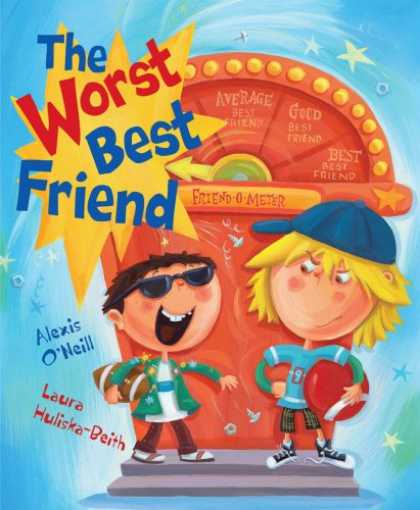
The Worst Best Friend by Alexis O'Neill and illustrated by Laura Huliska-Beith is a book that shows what true friendship means. It is a book I think children would really benefit from reading because I feel almost all children could relate to the message that is being presented. Friends want what is best for each other, they treat each other kindly even if they may be angry, and friends sometimes make mistakes.
Mike and Conrad are best-best friends. They do everything together, and they even have a special handshake. This all changes when a new boy named Victor joins the classroom. Conrad thinks Victor is great! He seems to completely forget about his best-best friend Mike. Mike becomes pretty upset and feels left out since Victor and Conrad now seem to be best friends. When a game of kickball is about to start (Mike and Victor are captains), something makes Mike realize he should be a good friend to Conrad even though he is upset. Victor tells Conrad he is too small for his team and that he wants him team to win. Therefore, he refuses to pick him. Mike feels sorry for his ex-best-best friend and decides to choose him for his team. In the end, Mike's team loses. However, Mike and Conrad learn a valuable lesson. Best-best friends should always treat each other nicely and be there for one another. Conrad apologizes to Mike, and they are able to do their handshake and return to being best-best friends.
I can totally see me reading this book to my future students. It sends a good message while being very realistic. Many children face a situation like Mike and Conrad were in. I really like how the author chose to portray their relationship with each other and how it changed when Victor entered the dynamics.
The illustrations in this book remind me of the cartoon "Jimmy Neutron". They are cartoon-like with a realistic look. The colors were all bright and seemed to jump off the page. The text was another really great aspect. The size, color, and font varied from page to page. It helped show what words to emphasize, and I think this can really help children while they read. Also, the way the text was presented was occasionally set-up differently as well (vertical, slanted, etc).
I would suggest this book to others. It is entertaining and presents a positive message to readers.
Fancy Nancy by Jane O'Connor and illustrated by Robin Preiss Glasser

Fancy Nancy by Jane O'Connor and illustrated by Robin Preiss Glasser is a book that I was anxious to check out from the curriculum lab and read. I had heard it is a huge hit with children, and I wanted to know why. Well, I can clearly see why many children have fallen in love with Fancy Nancy. However, I am not sure if this is entirely a good thing.
Fancy Nancy is a little girl who desires everything in her life to be fancy, elegant, and over the top. Her family doesn't have the same feelings about being fancy. Their clothes are not super sparkly, they do not over accessorize, and they certainly do not go around trying to make everything fancy. Therefore, Nancy thinks that her family needs lessons in being fancy. She offers to give them free fancy lessons. Well, of course her family chooses to hear what she has to say. They get "fancified". They accessorize their clothes, speak as though they are fancy, and decide to take their new personas out to dinner at "The Kings Crown" (which is a pizza parlor). It is clear that Nancy's family is doing this to make Nancy happy, and I think that this is great and I liked this element of the book. While at dinner, they talk about fancy things. They pretend they are French. They even order parfaits (fancy sundaes). However, the evening quickly comes to a halt when Nancy has an accident. She spills the parfaits all over the floor, so they quickly go home. Nancy removes all of her fancy accessories and appears to look like herself. When she goes downstairs, she realizes her family has made sundaes. She decides to thank them for being fancy for her and for the sundaes. She also tells them she loves them, and they tell her they love her. The author points out there is nothing better or fancier than saying "I love you". I thought this was a nice touch.
I have a small, small issue with Fancy Nancy. I feel as though it promotes the message that fancy is better. I know the author means for it to be cute and fun. In fact, I think it is for the most part. However, I think a little more of a "lesson" or realization that being fancy isn't everything would have been nice. Many children are unable to have fancy things, and this may make them feel a little left out while reading.
The pictures in this book were fantastic. They were so detailed. Everything was "fancy". It was clear that Robin Preiss Glasser, the illustrator, clearly understood the story that the author was telling. The colors were vibrant and the text was not typical and boring. It was fancy (haha).
I liked this book, and I am interested to read other Fancy Nancy books. I can see how many children (mostly young girls) would fall in love with Nancy and her adventures.
A Small Brown Dog With a Wet Pink Nose by Stephanie Stuve-Bodeen and illustrated by Linzi Hunter

A Small Brown Dog With a Wet Pink Nose by Stephanie-Bodeen and illustrated by Linzi Hunter was a creative story that I found pretty entertaining. Many children face opposition when asking their parents for a dog, and this book gives advice on how to convince their parents to get a family dog.
Amelia, the main character in this story, begs for a dog. However, her parents say that it isn't a good time right now. Therefore, Amelia comes up with a plan that she knows they will be unable to resist. She invents an imaginary dog! She feeds him, takes him on walks, plays with him, and sleeps with him. She decides to name him "Bones". Well, one day Bones goes missing. They cannot find him anywhere. Eventually, their search leads to an animal shelter. Amelia had previously made her parents promise they would find Bones and take him home. Well, Amelia "finds" Bones at the shelter when she sees a small brown dog with a wet pink nose. In the end, her parents decide that they must take Bones home with them.
I really liked this book. I think it is very relatable for many children (I know I always begged for pets until my parents gave in). I found it humorous that Amelia came up with a plan to trick her parents. She had asked certain questions and prepared to lose her imaginary dog in order to go to the shelter for a real one.
My favorite elements in this book had to do with the illustrations. One may wonder, how can one show an imaginary dog in a picture? Well, the dog was always outlined in a dotted line. The illustrations were mostly cartoon-like, but some of the pages had photographs of real dogs. I think this is a pretty clever technique. I also really liked how the text was not all the same. Some of the text was presented in conversation bubbles, some was enlarged or bolded, and it did not always follow the same pattern from page to page. There were often many scenes within the pages that were separated by dotted lines. The last page of the book has "Amelia's Guide to Getting Your First Dog" with all of the steps included for readers.
I think this book was fun and refreshing. I would recommend it to others.
Sunday, March 28, 2010
Year of Impossible Goodbyes by Sook Nyui Choi

Year of Impossible Goodbyes by Sook Nyui Choi was a book that left me with some mixed feelings after reading. There were some aspects I really enjoyed. However, during various parts of this book I found myself sidetracked and slightly confused. This book followed the life of Sookan and her family regarding their struggles they faced while living in Korea. In the beginning, the author focuses on their life under the Japanese rule. However, towards the end of the book, the focus is on Russia's involvement. Because of these occupations, life for Sookan and her family was very hard at times. They were ordered to follow the rules of others and many times that conflicted with their personal beliefs.
My favorite aspect of this book was the authors portrayal of the Japanese and Russian involvement in Korea and how it impacted Sookan and her family. It seemed very honest and did not sugarcoat the negative effects it had on their lives. The author explained the procedures, jobs, relationships, and ways of life in a way that made me feel as though I understood what was happening. However, I would have liked to have more of an explanation or more insight into how the adults felt about their situation. The book was from Sookan's perspective, however, so I can see why this would be omitted.
There were a few things about this book that I did not really like. One thing that bothered me the most was the passing of time. I was unsure of how much time had gone by between chapters. I would have liked that to be clearer. Also, at time I felt as though I was reading the same thing. I think I would have been more attentive if the author had decided to discuss more of the "daily life". I remember the parts that focused on the family troubles and community practices the most.
Overall, I think this book was alright. There were good aspects as well as others that I did not really enjoy. For a teacher who wanted to discuss the war/involvement of Korea, I think this book would be able to offer students a good insight.
Subscribe to:
Posts (Atom)